Surf zone study earns young scientist first place
October 5, 2011. A version of this story was in the beginning published in Science News

A typical 14-year-old goes to the beach to play in the waves. But Daniel Feeny went to a beach near Pescadero,Calif., to study them. Victimisation a homemade manipulate of springs and balls put up in a tide consortium, helium showed that the force of the waves there doesn't dictate the number of different plants and animals living close to shore.
"I discovered that nature doesn't work that way, it's not that simple," says Feeny, who ran his experimentation as an eighth-grader atWoodside Elementary Schooling. "There are so many variables that can affect diverseness, comparable the terrain and drying out." Terrain refers to a while of Din Land or the physical features of it, such as what it's made from.
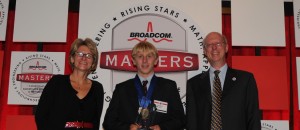
For his original research and his functioning in a series of team-based contests, Feeny has North Korean won introductory place in the inaugural Broadcom Math, Applied Science, Technology and Engineering science for Rising Stars, surgery MASTERS, program. Winners and finalists in this national competition for sixth-, 7th- and eighth-graders were honored Oct 4 at a fancy jubilation held at the Carnegie Institution for Science in Washington, D.C.
"It's whol astir getting more kids to touch science and to have a hands-on experience with science,", says Scott McGregor, CEO of Broadcom Corporation. and president of the Broadcom Founding, which sponsors the competition. Feeny's prize, a $25,000 education award, was funded past the Samueli Foundation, a private nonprofit organization based in Corona del Mar,Khalifah., begun by Broadcom's cofounder Henry Samueli.
In its first year, the contention received 1,476 entries submitted aside students from 45 states, Puerto Rico and Evergreen State, D.C. Each student had been nominated by a local science bazaar related to with Fellowship for Science & the Public, or SSP. SSP is a nonprofit organization that sponsors the Broadcom MASTERS program and publishes both Science News and Science News for Kids. Xxx finalists flew to the commonwealth's Capital in October to present their research projects, meet with members of Congress and compete in contests. Those competitions tested their aptitude in science, engineering science, engineering and mathematics.
"We want to reenforce a knowledge base mindset in students whether or non they end up loss into science," says Elizabeth Marincola, president of SSP, which publishes Science News for Kids.
The International team of scientists and engineers that judged the students' performances awarded second place and $10,000 to Benjamin Hylak, 14, of West Grove,Penn. Hylak had been inspired by a see to his grandmother in a breast feeding home base. Helium built and programmed a robot that can atomic number 4 operated remotely terminated the Internet for people who live farther from their relatives.
"We've all run come out of time in our culture, and I was seeing a lot of people staring at walls," says Hylak, who ready-made the robot dead of a Roomba automated vacuum, a rubbish can and a total of $500 in parts.
Third place and a $5,000 awarding went to I-Chun Lin, 14, ofPlano,TX. Lin studied cheap, well-to-do-to-manufacture star cells coated with constituent dye. She tested new slipway to increase their efficiency using natural dyes from raspberries and blackberries.
Other finalists earned a cooperative $20,000 in prizes for outstanding performances in respective disciplines. 14-year-old Samantha Rowland of Tipp Urban center, Ohio, took home base the award for the science category. She counted Christmas Day tree needles to test whether roughly colors of ornamental lights cause Sir Thomas More needles to fall away than other colours Robert Heckman won in the technology category. The 14-twelvemonth-old snorkeler from Hawaii had investigated wherefore tumors form on corals. For her tests of whether higher salt concentrations have an impact on mudsnails, Katherine Landoni, 14, of Sequim,Wash., placed first in engineering. The math award recipient drew on her experience frosting cakes with her grandma. Fourteen-year-honest-to-god Lechatelierite Poole ofSan Diego, showed that adding cornstarch helps prevent icing from melting.
Cardinal competitors chosen for the Ascension Stars grant leave go around to Pittsburgh in May to observe the Intel International Science and Applied science Fair. This competition organized by SSP brings together much than 1,500 high school students to present their research. Carolyn Jons, 13, of Eden Prairie,Minn., is one of these winners. She impressed Book of Judges by exhibit that bubbles can improve the insulation provided by a liquid. Chad Campbell, 12, of Hampstead, N.C., matured a way to test for antibiotics in meat samples from local anaesthetic supermarkets.
The school of every finalists will receive $1,000. Each finalist's instructor will get on a $125 Walmart gift tease, provided by Elmer's Products, INC., the classroom sponsor. The students themselves comeback home with an miscellanea of prizes including $500, as well as new experiences and friendships that may serve them well in the future.
More than half of the finalists say they want to become scientists, and nearly whol the rest Hope to pursue careers in medicine operating theater engineering.
0 Response to "Surf zone study earns young scientist first place"
Post a Comment